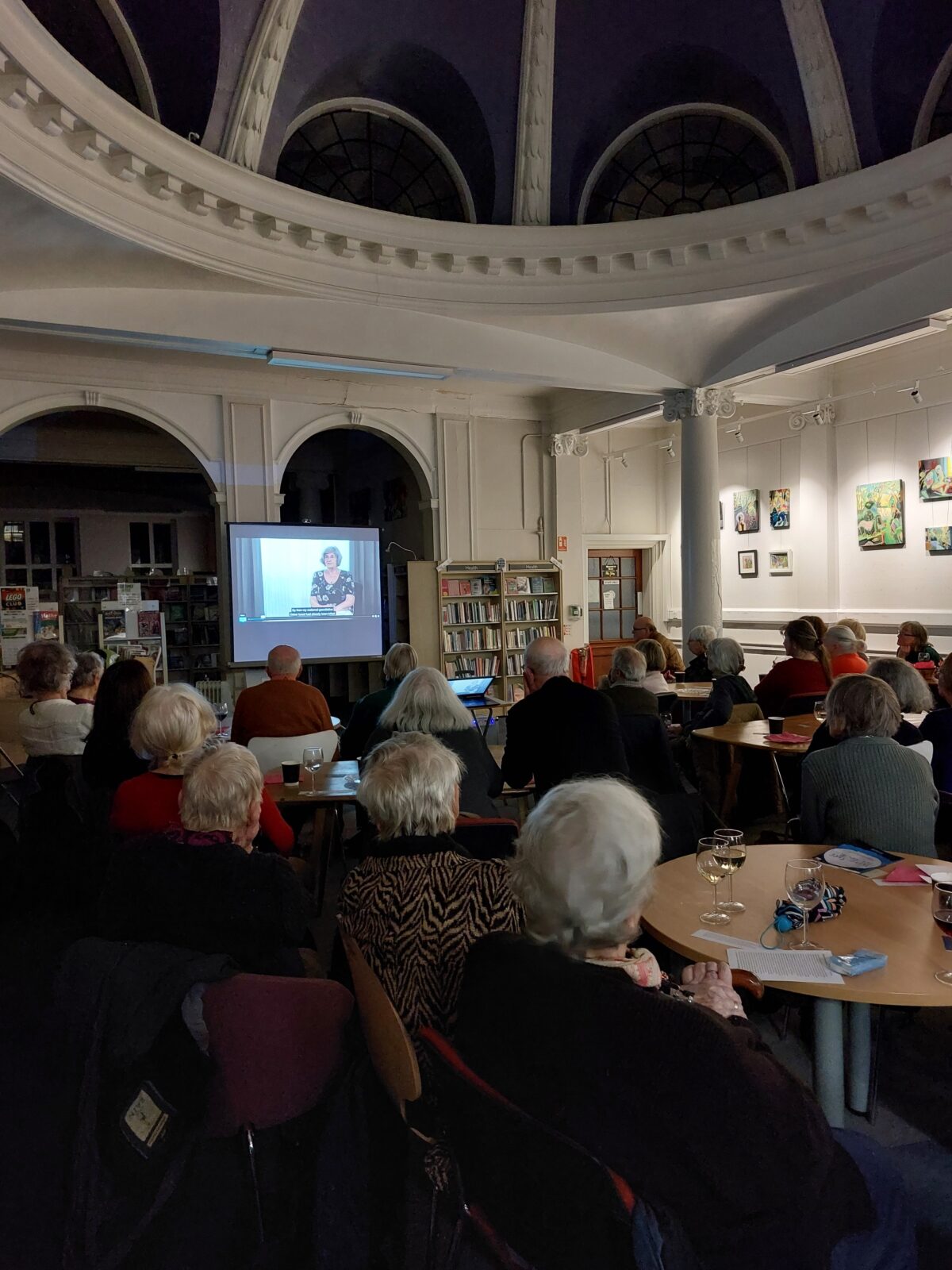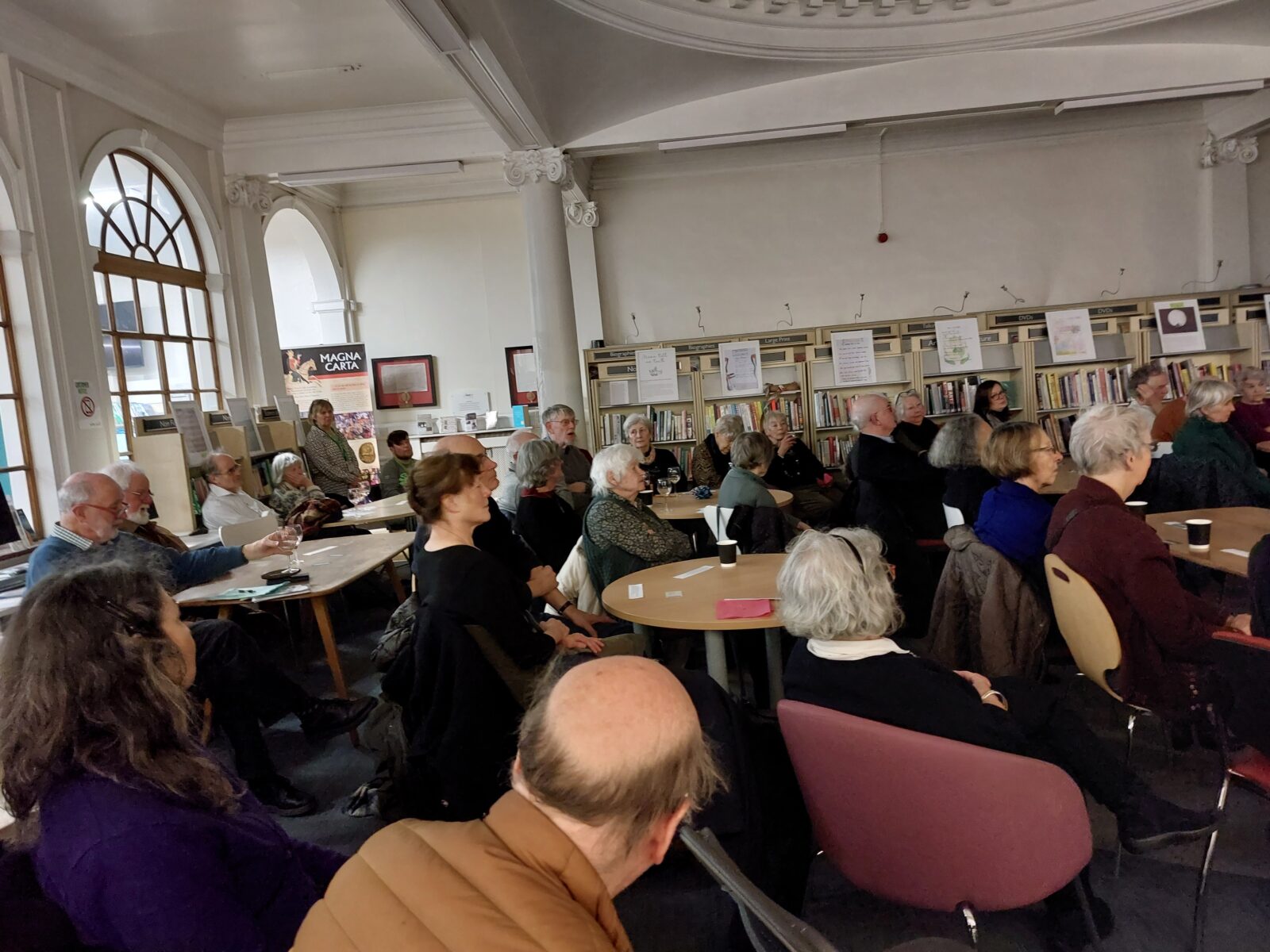
‘Celebration’ might be the wrong word for what a large audience took part in last night at the wonderful West Greenwich Library. And yet the word did crop up a few times. As well as deploring cruelty and crying for the victims, we must also celebrate the resilience, courage and selflessness of survivors and of the individuals and families who put their lives at grave risk to protect others.
Shivaun Woolfson presented ‘Surviving History: Portraits from Vilna’, a documentary made in 2008 (and still sadly relevant) by her and her sons Daniel and Jesse Quinones (Wolfcub Productions) in Lithuania, where their family originated from. A trip that was much more than ‘fact-finding’. Having recently lost both her parents, Shivaun felt the urge to find some meaningful family and cultural traces. What she found was a town where skinheads still marched chanting ‘Jews Out!’, where the remaining Jewish community had dwindled to a small number of elderly and very old people. The memory of what happened to the once thriving community would disappear with them, were it not for a small, tucked-away Jewish museum, dedicated to preserving those memories, to recovering the faces and names of those who were killed by their neighbours, as well as by the German SS.
Shivaun interviewed some of the survivors, who showed such humanity in the face of indescribable and still-fresh sorrow. All we could do at the end of the short film was to sit in silence for a short moment.
After some questions to Shivaun and an interval, we watched ‘Hidden Childhood: Vesna’s Story’. The documentary, produced and kindly supplied by the Zagreb Festival of Tolerance, charted, in Vesna Domany Hardy’s own words, the terrible events that affected her and her family during WW2, with the assassination of her Father, the Resistance work of her Mother – through to the post-war years and her Mother’s two year internment under Tito’s communist (but not Stalinist) regime on the notorious island of Goli Otok. This complicated, painful story is also populated by courageous, selfless people, by quiet heroism and startling resilience.
There were some questions, too, at the end of Vesna’s Story, and many heartfelt pleas for peace, tolerance (or, even better, a welcoming, open attitude to differences and diversity).
Just for one night, to coincide with this event, a few library shelves were devoted to a display of prints of very poignant poems and pictures written and drawn by Palestinian children in early 2023, as part of an English language project (www.handsupproject.org) and now collected in a book called Moon Tell me the Truth. This display, and its explanatory notes by Mick Delap, who promoted the display, added to the poignancy of the evening.
We all feel that oral histories and testimonies, in whatever form, are essential to our mutual understanding at this time of great global turmoil and appalling suffering.
A big thank you to Shivaun and Vesna (I feel privileged to be their friend).
I also wish to thank Natasa Popovic of the Zagreb Festival of Tolerance, Wolfcub Productions, Mick Delap and the amazing audience and, as always, Debra Sullivan and her staff at the Library for all their help and support over this important event.
Shivaun Woolfson is a writer and lecturer, with a special interest in life history writing, research and practice. She holds a PhD in history and has taught extensively in the US and the UK, most recently at Goldsmiths College, University of London, where she served as Senior Tutor in Community Studies and visiting lecturer in life writing. She has facilitated workshops, seminars, public readings, performances and writing residences in hospices, prisons and community centres. She has also developed numerous interdisciplinary arts projects based primarily on the life experiences of participants. In 2002, she published an autobiography, Home Fires (Atlantic Books). Between 2008 and 2009, Shivaun fielded a team and made numerous trips to Lithuania to conduct fieldwork research for the project ‘Surviving History – Portraits from Vilna’. The project ultimately culminated in the short documentary we have watched, and a travelling exhibition, which opened at the Tolerance Centre in Vilnius in September 2009. Between 2009 and 2011, the exhibition toured – among other locations – the Holocaust museums in Cape Town, Johannesburg and Durban, University College Dublin, Shropshire Council’s Shire Hall, Central Synagogue in London, London Jewish Cultural Centre, and Biddenham Upper School, Bedfordshire. During that time, Shivaun also conducted several teachers’ seminars and public talks relating to Holocaust legacy in Lithuania.
Vesna Domany Hardy was born and educated in Zagreb, Croatia. She obtained a degree in Comparative Literature and English language and Literature at the University of Zagreb, and much later an MA in Art History from Goldsmiths College, London. In 1974 she left Yugoslavia to join her English husband in his British Council posting in Pakistan. That posting was followed by one in Paris and, after two years in Greenwich, by two in Italy, in Milan and Rome, before the family returned to London. Vesna made the most of these experiences by continuing to study, write, translate and work for radio, schools and cultural institutions. Vesna was one of ten women who founded the Croatian Peace Forum to counteract the lies about the causes of the conflict in the former Yugoslavia, and to lobby for peace. After Croatian independence, she continued working with refugees from Bosnia, especially children, and coordinated a project, aiming to reunite war-dispersed families. She also worked as an interpreter on the ICTY investigation into the war crimes committed on the territory of the former Yugoslavia. Vesna’s links with her country of origin and her own roots are deep and important: she is continuing to write and to collaborate with several newspapers in Croatia, contributing regularly to a Croatian Jewish cultural magazine and sitting on the board of the Jewish Festival of Tolerance in Zagreb. She is on the Holocaust Education Trust’s list of survivors and provides talks on the Holocaust to schools.